AI choose-your-own-adventure, in a longer lineage.
The format started with a paperback in 1979. Forty-some years later, a generation of readers is meeting it again - this time with a story that remembers them.
In 1976, a New Jersey lawyer named Edward Packard wrote down a story for his daughters in which they could choose what happened next. He had been telling them stories like that out loud for years - at a certain point in the plot he would stop, and ask, and they would decide. He just hadn't thought of it as a book.
A few years later, Bantam picked the idea up and started a series of orange-spined paperbacks called Choose Your Own Adventure. The Cave of Time. Journey Under the Sea. By Balloon to the Sahara. A whole generation read them with both thumbs jammed into the book at once - one holding the page you were about to choose, the other holding the page you might choose instead, in case the first one ended in being eaten.
What worked about them, then and now, is the small adult feeling of being addressed. The story stops, looks at the reader, and says: I'd like to know what you think. It is the opposite of being told a story at. It is being told a story with.
What's different about an AI one
The Bantam paperbacks were brilliant inside a constraint: a finite tree of pages, printed once. Every branch had to exist before you opened the book. The author worked out the skeleton in advance and rationed pages to each path - which is why some endings felt thin, and why your second read-through hit the same paragraphs as your first.
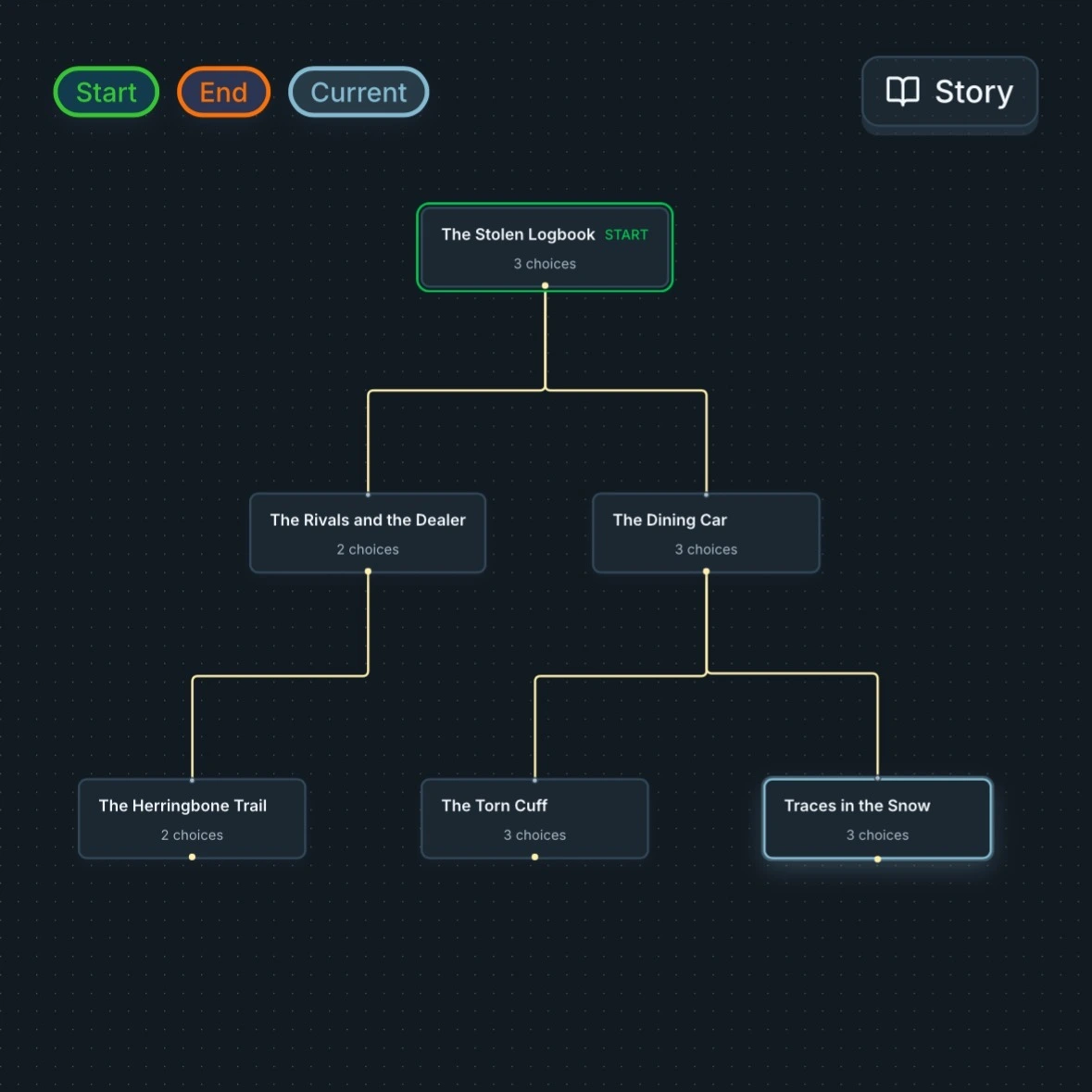
An AI choose-your-own-adventure doesn't have that constraint. Cosmonaut writes each branch when you ask for it, in the same voice, with the same characters, in the same world. The path you pick becomes a chapter that didn't exist five seconds ago and won't exist for anyone else. The tree is as deep as you want to go.
And, critically, it remembers. A choice you made on the second page is still true on the ninth. The shopkeeper who saw you palm an apple in chapter three recognizes you in chapter six. That continuity is the thing that turns a branching exercise into a real story.
What a small story looks like
For families
The best way to use Cosmonaut, in our biased opinion, is the way Edward Packard used the form in the first place: out loud, with a kid. Set up a story together. Read the chapter aloud. Argue about the choice. See where you end up. On the Cosmonaut tier, audio narration will read the chapter for you, so you can listen along instead of holding a phone.
Cosmonaut is meant to be a shared activity, not solo screen time for a young reader. Children under 13 should always use it with a parent or guardian. There is no NSFW mode, no adult roleplay, no infinite feed - the story waits politely for the next person to look at it.